Having some time to kill--no pun intended--before rousing a child for the first day of school, I drafted the following epistle to the governor of South Dakota in re some comments he had made in yesterday's edition of the Sioux Falls (SD) Argus Leader:
Dear Governor Rounds,
A portion of your interview with the Argus Leader, as published in yesterday's edition, surprised me greatly:
"Q: And the church has taken a position against the death penalty?
"A: I don't think that's quite correct. ... The death penalty is there for a reason in order that under selective and unique circumstances and based on individual review, it may be something in limited circumstances that is appropriate, when an individual does great damage to society. The church recognizes the responsibility of government leaders to carry out the law of the land."
Surely you must know that the US Conference of Catholic Bishops has waged a 25-year campaign to eliminate the death penalty. I would encourage you to visit the Conference's web site, http://www.usccb.org/sdwp/national/deathpenalty/index.shtml, which includes much helpful information about not only the Church's teachings on the subject but also why the death penalty is an ineffective and evil punishment.
I would refer you also to the comments made in a 1999 homily by Pope John Paul II in St. Louis, Missouri:
"The new evangelization calls for followers of Christ who are unconditionally pro-life: who will proclaim, celebrate and serve the Gospel of Life in every situation. A sign of hope is the increasing recognition that the dignity of human life must never be taken away, even in the case of someone who has done great evil. Modern society has the means of protecting itself, without definitively denying criminals the chance to reform. I renew the appeal I made most recently at Christmas for a consensus to end the death penalty, which is both cruel and unnecessary."
Undoubtedly, the Church does recognize "the responsibility of government leaders to carry out the law of the land," as you say. However, the law of the land empowers you to commute a death sentence. To sentence Elijah Page, or any other death-row inmate, to life in prison without parole provides the good (removing him as a threat to society) without compounding the evil (meeting violence with more violence).
As you may know from my previous communications with you, in which I encouraged you to veto HB 1215, I am a pro-choice Catholic. But I am also pro-life (the two are not mutually exclusive). As such, I strongly and respectfully encourage you to reject what has been termed the culture of death, and show that, contrary to our recent image, the state of South Dakota is home to compassionate and merciful people.
Sincerely,
William J Reynolds
Of course, the odds of my well-reasoned (and, you must admit, oh-so-polite) missive actually changing the man's mind are about the same as were the odds of my previous message to him, urging him to not sign our now-infamous abortion bill into law, viz., nil. Which are precisely the same chances of my voting for him in the future. To be fair, I haven't voted for him in the past, so he's not really losing anything. Except some of my respect.
Elsewhere in the same interview excerpted above, Rounds makes the tired old argument, in "defense" of his being pro-life when it comes to fetuses but not when it comes to actual breathing human beings, that somehow the life of the living is worth less than the life of the unborn:
"Q: You have consistently said that you oppose abortion, and you signed House Bill 1215 that would ban most abortions. Is it consistent to be pro-life on abortion and also to favor the death penalty?
"A: There's a real difference between an innocent human being and someone who has been convicted in a court of law of murdering another human being and may do it again."
Yikes. Where to begin? Well, first off, were the governor to commute Elijah Page's sentence (Page being the death-row inmate on whom the current furor is centered) to life in prison without parole, that would pretty much take care of the "he may do it again" argument. I suppose there is a chance that he might murder one of his fellow inmates, but it seems the prison system could take steps to protect against that, if it is indeed a real threat.
That leaves us, then, with the "innocent human being" angle. This is not something that the governor invented; indeed, I have heard Catholic priests make the same unsettling argument in opposition to abortion. The problem for me is this: Which of us gets to decide whose life is worth more? And by what criteria? Okay, let's say for the sake of argument that a convicted murderer's life is worth less than an "innocent human being." What about a convicted car thief? A convicted check forger? What if we are weighing the life of the car thief against that of the check forger? Whose life is "worth" more. And how much more?
Setting aside for the moment the idea of original sin, which I think the Catholic Church still holds and which calls the whole notion of an "innocent human being" into some question in the first place, the very idea that we would, as a society, head into the rocky terrain of "whose life is worth more" is quite reprehensible and morally indefensible. Is the life of an incurably ill person on life support "worth less"? If so, why are we as a society (and, quite vocally, the Catholic Church) opposed to euthanasia? Simply because of the long-held belief that life, all life, has worth.
I have been informed more than once that I "can't be pro-life and pro-choice." Of course, that's just silly--the mere fact that I am both proves that I can be both--but I maintain that one cannot logically profess to being pro-life as well as pro-death penalty. If life is life, then simple honesty requires such an individual to identify himself not as pro-life but anti-abortion.
There is, obviously, a difference.
Monday, August 21, 2006


Thursday, August 17, 2006
Culture of Death
When he signed South Dakota's heartlessly draconian take-no-prisoners abortion bill into law earlier this year, Governor Mike Rounds seemed to be positioning himself as "pro-life." Some folks, with more than a little schmeer of bigotry, hinted that his actions were to be expected since, after all, he is a Catholic. But now, with South Dakota's first execution in more than half a century in the offing, the governor appears to be distancing himself from any hint of pro-life-ness--and incidentally from the teachings of his church.
The governor's reasons for not blocking the execution of death-row inmate Elijah Page are at best peculiar. "Gov. Mike Rounds could stop it by ordering a delay or by changing the sentence to something less severe," writes the Sioux Falls (SD) Argus Leader. "But he believes in capital punishment and calls Page's deed a crime of extreme cruelty. 'At this point, I don't have any plans to intervene,' Rounds said."
No one argues that Page is innocent (not even Page), or that he shouldn't be punished. Hell, I'd say most of us agree that life in prison without parole is probably too good for the murder scum. But for the governor--and plenty of other folks, too--to be so firmly committed to "protecting" life on the one hand and so willing (perhaps eager?) to extinguish it on the other is, well, peculiar.
And so much for the governor acting at the behest of his (and my) church: The Roman Catholic Church has repeatedly come out in opposition to capital punishment as well as abortion...but it has not escaped my attention that the more rightist elements of the church, while extraordinarily pious and obedient in following church teachings when it comes to the unborn, manage to become deaf when it comes to folks who are already with us.
Curiously, the fact that Page has put a stop to his appeals process and evidently wishes the execution to go forward seems to count a lot for the governor and other supporters of the death penalty. Why his wishes enter into it at all is beyond me. If he indicated a desire to not be put to death, would the state honor that wish? If he tried to commit suicide in his cell, would not the state move to stop him or, failing that, preserve his life? Why, if his desire to die is all-important?
In the end, I find myself again facing the strange inconsistencies of the right-wing mentality. If one is really and truly "pro-life," then one must be as adamantly opposed to the death penalty as he is to abortion. There is no way around it: life is life, life is sacred, and only God gets to decide when to end life. Otherwise one is merely anti-abortion.
That's fine, but then have the honesty to say so.
The governor's reasons for not blocking the execution of death-row inmate Elijah Page are at best peculiar. "Gov. Mike Rounds could stop it by ordering a delay or by changing the sentence to something less severe," writes the Sioux Falls (SD) Argus Leader. "But he believes in capital punishment and calls Page's deed a crime of extreme cruelty. 'At this point, I don't have any plans to intervene,' Rounds said."
No one argues that Page is innocent (not even Page), or that he shouldn't be punished. Hell, I'd say most of us agree that life in prison without parole is probably too good for the murder scum. But for the governor--and plenty of other folks, too--to be so firmly committed to "protecting" life on the one hand and so willing (perhaps eager?) to extinguish it on the other is, well, peculiar.
And so much for the governor acting at the behest of his (and my) church: The Roman Catholic Church has repeatedly come out in opposition to capital punishment as well as abortion...but it has not escaped my attention that the more rightist elements of the church, while extraordinarily pious and obedient in following church teachings when it comes to the unborn, manage to become deaf when it comes to folks who are already with us.
Curiously, the fact that Page has put a stop to his appeals process and evidently wishes the execution to go forward seems to count a lot for the governor and other supporters of the death penalty. Why his wishes enter into it at all is beyond me. If he indicated a desire to not be put to death, would the state honor that wish? If he tried to commit suicide in his cell, would not the state move to stop him or, failing that, preserve his life? Why, if his desire to die is all-important?
In the end, I find myself again facing the strange inconsistencies of the right-wing mentality. If one is really and truly "pro-life," then one must be as adamantly opposed to the death penalty as he is to abortion. There is no way around it: life is life, life is sacred, and only God gets to decide when to end life. Otherwise one is merely anti-abortion.
That's fine, but then have the honesty to say so.
Wednesday, August 09, 2006
"Truth Is Stranger," or "A Stranger to Truth"?
Funny. When I ask acquaintances why they associate themselves with the Republican Party, a frequent "reason" is that they consider Republicans more "moral" than Democrats. Evidently they've never heard of Newt Gingrich, or Karl Rove, or Tom Delay, or Lee Breard.
What, you've never heard of Lee Breard either? Not to worry: probably only a few had until this past week. Breard is the campaign manager for Bruce Whalen, the GOP nominee for South Dakota's sole seat in the US House of Representatives. Whalen is running (uphill) against incumbent Representative Stephanie Herseth, of whom I'm written before.
All well and good. Except that last week Breard seems to have put his foot in it big time. Now it looks to me like he's got both feet in it. And is sunk in about up to his waist.
Here's how I understand the sequence of events.
For some reason, Breard was on Wikipedia looking up Herseth. Don't know why. You'd think that, as campaign manager for Herseth's opponent, he'd already have done his homework. But there you have it. Anyway, some fun-loving scamp had gone into Wikipedia and, ahem, edited the Herseth biography to claim that she had recently converted to pro-lifism having turned up pregnant, and is now engaged to be married to her chief of staff.
I know what you're thinking: Anyone with a clue would know that's a hoax. But the world is full of the clueless. And rapscallions. Lee Breard, upon seeing this bogus bio, does what any member of the "moral" party would do: he starts sending it around to reporters. Later he will claim that he did so to verify the item. Obviously contacting Herseth's office never occurred to him. Even better, his quest for the truth included a comment in his e-mail to the effect that if the claim were true it would be quite a change for a "home-wrecker" such as he claimed Herseth to be. (This based on nasty rumors circulating for some time that Herseth was involved with a married former congressman from Texas. Never mind that she and the gentleman met some time after his divorce was finalized. Details like the truth matter little to the "moral" folk in the GOP.)
The Rapid City (SD) Journal, however, seems to have a more solid acquaintance with the truth, and broke the whole tawdry story last Friday.
Now things get weird. I know, I know: Weirder, then.
First Breard tries out the I-was-only-trying-to-help balderdash, insisting that his spreading scurrilous gossip was in fact his way of getting to the truth. Riiiight.
Then when it's suggested that Whalen owes Herseth an apology, the "explanation" comes that Whalen himself--the candidate, remember?--knew nothing about Breard's actions, so there's no reason to apologize. Now think about that: the candidate doesn't know what his campaign manager is doing. So the candidate hides behind his impenetrable Cloak of Ignorance. Which tends to speak volumes about how he'd serve in the United States Congress. The campaign manager, meanwhile, doesn't have the decency to say, "Well, yes, obviously I was wrong and I'm sorry." Since the words "I was wrong" and "I'm sorry" are also alien to those "moral" GOPers.
Keep in mind that we don't know who was behind the alteration of the Wikipedia bio in the first place. One hates to be suspicious (not really, but it seems polite to say so), but in light of the general seaminess of the whole Breard affair...
I'm sure that the fact that a poll conducted last week shows Herseth with a 60-26 lead over Whalen (14 percent undecided) had nothing at all to do with these shenanigans.
But getting back to my acquaintances who insist they align with the GOP because of its greater "moral" credence: I don't know what to make of them. These are not bad people, not evildoers or ne'er-do-wells. They consider themselves good, decent folks, and most people would agree with them. But what does it say about people who can continue to turn a blind eye and deaf ear toward years and years of lies, lawbreaking, dirty tricks, and other assorted malfeasances and continue to believe that "their" party somehow possesses the moral high ground? And how long can a "good" person continue to ignore the evil going on around him before he loses the right to consider himself "good?"
At the very least, must there not come some point at which you acknowledge that "your" party or "your" candidate stumbled? Doesn't simple decency require that we hold ourselves and our fellows to the same standards, if not higher ones, than we hold "the other guys?" Is not that the basic measure of "morality," the foundation on which it rests? I voted for Bill Clinton twice, and would again if given the chance...but there's no way on the planet I could or can see Monicagate as anything but a horrible moral lapse. No question about it. He was wrong. There--was that so difficult to say?
Why, then, do so many GOPers find it so impossible to admit that "their guy" might be wrong about something? Are their egos really so fragile that the idea that someone they voted for might not be infallible sends them into a thumb-sucking fetal fugue?
We can take some comfort in the fact that it appears virtually impossible for Whalen to win the upcoming congressional election, and that whatever it was that his campaign manager thought he was doing (without the candidate's knowledge, I guess), the effect seems to have been to make the entire campaign a joke and its "manager" a clown at best and a sleaze at worst. But it's not really much comfort.
What, you've never heard of Lee Breard either? Not to worry: probably only a few had until this past week. Breard is the campaign manager for Bruce Whalen, the GOP nominee for South Dakota's sole seat in the US House of Representatives. Whalen is running (uphill) against incumbent Representative Stephanie Herseth, of whom I'm written before.
All well and good. Except that last week Breard seems to have put his foot in it big time. Now it looks to me like he's got both feet in it. And is sunk in about up to his waist.
Here's how I understand the sequence of events.
For some reason, Breard was on Wikipedia looking up Herseth. Don't know why. You'd think that, as campaign manager for Herseth's opponent, he'd already have done his homework. But there you have it. Anyway, some fun-loving scamp had gone into Wikipedia and, ahem, edited the Herseth biography to claim that she had recently converted to pro-lifism having turned up pregnant, and is now engaged to be married to her chief of staff.
I know what you're thinking: Anyone with a clue would know that's a hoax. But the world is full of the clueless. And rapscallions. Lee Breard, upon seeing this bogus bio, does what any member of the "moral" party would do: he starts sending it around to reporters. Later he will claim that he did so to verify the item. Obviously contacting Herseth's office never occurred to him. Even better, his quest for the truth included a comment in his e-mail to the effect that if the claim were true it would be quite a change for a "home-wrecker" such as he claimed Herseth to be. (This based on nasty rumors circulating for some time that Herseth was involved with a married former congressman from Texas. Never mind that she and the gentleman met some time after his divorce was finalized. Details like the truth matter little to the "moral" folk in the GOP.)
The Rapid City (SD) Journal, however, seems to have a more solid acquaintance with the truth, and broke the whole tawdry story last Friday.
Now things get weird. I know, I know: Weirder, then.
First Breard tries out the I-was-only-trying-to-help balderdash, insisting that his spreading scurrilous gossip was in fact his way of getting to the truth. Riiiight.
Then when it's suggested that Whalen owes Herseth an apology, the "explanation" comes that Whalen himself--the candidate, remember?--knew nothing about Breard's actions, so there's no reason to apologize. Now think about that: the candidate doesn't know what his campaign manager is doing. So the candidate hides behind his impenetrable Cloak of Ignorance. Which tends to speak volumes about how he'd serve in the United States Congress. The campaign manager, meanwhile, doesn't have the decency to say, "Well, yes, obviously I was wrong and I'm sorry." Since the words "I was wrong" and "I'm sorry" are also alien to those "moral" GOPers.
Keep in mind that we don't know who was behind the alteration of the Wikipedia bio in the first place. One hates to be suspicious (not really, but it seems polite to say so), but in light of the general seaminess of the whole Breard affair...
I'm sure that the fact that a poll conducted last week shows Herseth with a 60-26 lead over Whalen (14 percent undecided) had nothing at all to do with these shenanigans.
But getting back to my acquaintances who insist they align with the GOP because of its greater "moral" credence: I don't know what to make of them. These are not bad people, not evildoers or ne'er-do-wells. They consider themselves good, decent folks, and most people would agree with them. But what does it say about people who can continue to turn a blind eye and deaf ear toward years and years of lies, lawbreaking, dirty tricks, and other assorted malfeasances and continue to believe that "their" party somehow possesses the moral high ground? And how long can a "good" person continue to ignore the evil going on around him before he loses the right to consider himself "good?"
At the very least, must there not come some point at which you acknowledge that "your" party or "your" candidate stumbled? Doesn't simple decency require that we hold ourselves and our fellows to the same standards, if not higher ones, than we hold "the other guys?" Is not that the basic measure of "morality," the foundation on which it rests? I voted for Bill Clinton twice, and would again if given the chance...but there's no way on the planet I could or can see Monicagate as anything but a horrible moral lapse. No question about it. He was wrong. There--was that so difficult to say?
Why, then, do so many GOPers find it so impossible to admit that "their guy" might be wrong about something? Are their egos really so fragile that the idea that someone they voted for might not be infallible sends them into a thumb-sucking fetal fugue?
We can take some comfort in the fact that it appears virtually impossible for Whalen to win the upcoming congressional election, and that whatever it was that his campaign manager thought he was doing (without the candidate's knowledge, I guess), the effect seems to have been to make the entire campaign a joke and its "manager" a clown at best and a sleaze at worst. But it's not really much comfort.
Thursday, July 20, 2006
At Least Grant Saw Combat
My friend Jerry proposes this book title: At Least Grant Saw Combat: Corruption and Mismanagement in the Administration of George W. Bush. It would be an easy book to write...
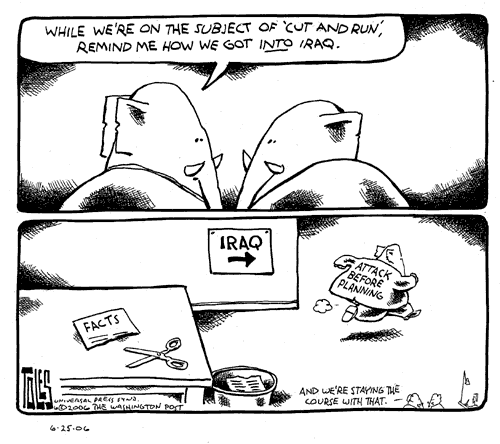
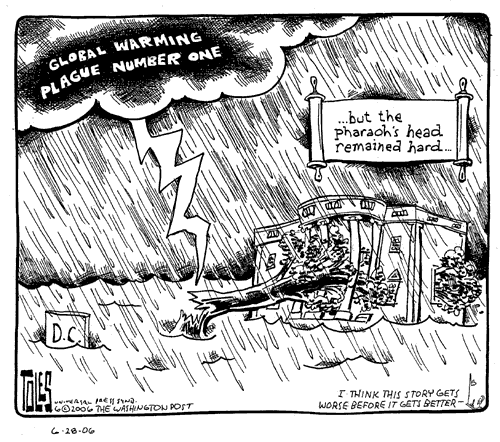
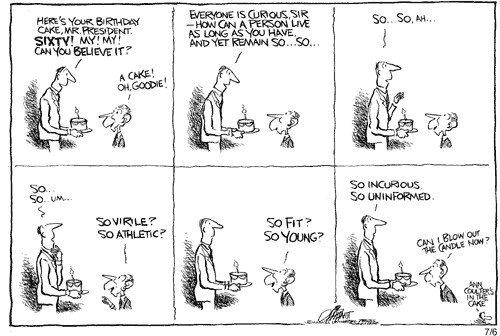
He also sends along these cartoons:


He also sends along these cartoons:


Good Prose Is Like a Windowpane
Again, some quotations that caught my eye. Most, though not all, are from A Word a Day.
Good prose is like a windowpane. -George Orwell, writer (1903-1950)
One of my greatest pleasures in writing has come from the thought that perhaps my work might annoy someone of comfortably pretentious position. Then comes the saddening realization that such people rarely read. -John Kenneth Galbraith, economist (1908-2006)
The man who views the world at 50 the same as he did at 20 has wasted 30 years of his life. -Muhammad Ali
Disappointed (Temporarily?)
I have been lately disappointed with my lone delegate to the U.S. House of Representatives, Stephanie Herseth (D-SD). First she goes and co-sponsors a House Resolution to amend the United States Constitution to ban flag burning (HJ RES10); now she’s gone and voted in favor of an amendment to ban gay marriage (HJ RES 88).
Now let’s get a couple of things clear: I don’t much care how Rep. Herseth feels about these issues. I'm well past the point where I think that "my" representatives at any level of government must agree with everything I think. Personally, I think both of these "issues" are non-issues -- from what I’ve read on the subject, a mere handful of flag burnings occurs in any given year (a number I would expect to actually increase if a constitutional amendment is passed -- sort of like putting a wet paint sign on a freshly painted wall: it’s an invitation to touch it); and I hardly see where the so-called institution of marriage is in any danger from same-gender couples who want to be married…indeed, it seems to me that their desire to be married in fact strengthens the institution, and will do more to promote the benefits of marriage, commitment, monogamy, etc., than to somehow undermine it* -- both are merely political-hay makers, and Ms. Herseth is probably wise to play to her audience, which is mostly conservative and mostly Republicans.
_______
*I also believe, as expressed elsewhere, that if you really want to “save” marriage, you should be looking at a constitutional ban on divorce…but I digress.
Monday, July 10, 2006
Sez Who?
Yes, it's another batch of quotations...
It does me no injury for my neighbor to say there are twenty gods or no God. -Thomas Jefferson, third US president, architect and author
(1743-1826)
Religion--freedom--vengeance--what you will, A word's enough to raise mankind to kill. -Lord Byron, poet (1788-1824)
Adulthood is the ever-shrinking period between childhood and old age. It is the apparent aim of modern industrial societies to reduce this period to a minimum. -Thomas Szasz, author, professor of psychiatry (1920- )
By the age of six the average child will have completed the basic American education. ... From television, the child will have learned how to pick a lock, commit a fairly elaborate bank holdup, prevent wetness all day long, get the laundry twice as white, and kill people with a variety of sophisticated armaments. -Russell Baker, columnist and author (1925- )
It's hard to be religious when certain people are never incinerated by bolts of lightning. -Bill Watterson, comic strip artist (1958- ), in his comic strip Calvin & Hobbes
For God's sake don't say yes until I've finished talking. -Darryl F. Zanuck, movie producer, director, and actor (1902-1979)
A myth is a fixed way of looking at the world which cannot be destroyed because, looked at through the myth, all evidence supports the myth. -Edward De Bono, consultant, writer, and speaker (1933- )
The object of most prayers is to wangle an advance on good intentions. -Robert Brault, software developer, writer (1973- )
The man who prefers his country before any other duty shows the same spirit as the man who surrenders every right to the state. They both deny that right is superior to authority. -Lord Acton, historian (1834-1902)
It does me no injury for my neighbor to say there are twenty gods or no God. -Thomas Jefferson, third US president, architect and author
(1743-1826)
Religion--freedom--vengeance--what you will, A word's enough to raise mankind to kill. -Lord Byron, poet (1788-1824)
Adulthood is the ever-shrinking period between childhood and old age. It is the apparent aim of modern industrial societies to reduce this period to a minimum. -Thomas Szasz, author, professor of psychiatry (1920- )
By the age of six the average child will have completed the basic American education. ... From television, the child will have learned how to pick a lock, commit a fairly elaborate bank holdup, prevent wetness all day long, get the laundry twice as white, and kill people with a variety of sophisticated armaments. -Russell Baker, columnist and author (1925- )
It's hard to be religious when certain people are never incinerated by bolts of lightning. -Bill Watterson, comic strip artist (1958- ), in his comic strip Calvin & Hobbes
For God's sake don't say yes until I've finished talking. -Darryl F. Zanuck, movie producer, director, and actor (1902-1979)
A myth is a fixed way of looking at the world which cannot be destroyed because, looked at through the myth, all evidence supports the myth. -Edward De Bono, consultant, writer, and speaker (1933- )
The object of most prayers is to wangle an advance on good intentions. -Robert Brault, software developer, writer (1973- )
The man who prefers his country before any other duty shows the same spirit as the man who surrenders every right to the state. They both deny that right is superior to authority. -Lord Acton, historian (1834-1902)
Sunday, July 09, 2006


Tuesday, July 04, 2006
Conservative Hypocrisy
I have to give them credit, I guess--conservatives in the 21st century are very good at double-speak, very good at convincing people to vote against their own best interests. You can't do that without also being very good at deceit and hypocrisy.
Case in point: Conservatives whine and moan about "government interference." To hear them tell it, they believe in a near-complete right to be left to fend for themselves. In trying to dismantle Social Security, a favorite rallying cry for conservatives is, "They think you're too stupid to manage your own money."
However (and setting aside for the moment the fact that plenty of people ARE too stupid to manage their own money...and that even the smartest person in the world is helpless before, say, a market collapse or the calumny of an Enron, which is why Social Security was devised in the first place), it so happens that I live in the state which has made itself (in)famous for passing the most restrictive abortion law in the country. Basically, you can't get an abortion here--no exceptions, not for the life or health of the mother, not for instances of rape or incest...nothing.
In other words, in their vast, bottomless hypocrisy, conservatives see nothing wrong with the government making health decisions for women (and girls)--they see nothing wrong with hated government interference as long as they get to dictate the terms.
And I choose the word "dictate" with care. As time passes, I view the ringleaders of the modern conservative conspiracy to have nothing less in mind than the complete undermining of the real America--that is, a truly representative democracy of, by, and for the people--and its replacement by a dictatorial one-party regime that will stop at nothing to assume total power over the American people...too many of whom seem, sheeplike, to think it must be all right if "good" conservative "authorities" say so.
One can only hope they come to their senses while there's still something left of the United States.
Case in point: Conservatives whine and moan about "government interference." To hear them tell it, they believe in a near-complete right to be left to fend for themselves. In trying to dismantle Social Security, a favorite rallying cry for conservatives is, "They think you're too stupid to manage your own money."
However (and setting aside for the moment the fact that plenty of people ARE too stupid to manage their own money...and that even the smartest person in the world is helpless before, say, a market collapse or the calumny of an Enron, which is why Social Security was devised in the first place), it so happens that I live in the state which has made itself (in)famous for passing the most restrictive abortion law in the country. Basically, you can't get an abortion here--no exceptions, not for the life or health of the mother, not for instances of rape or incest...nothing.
In other words, in their vast, bottomless hypocrisy, conservatives see nothing wrong with the government making health decisions for women (and girls)--they see nothing wrong with hated government interference as long as they get to dictate the terms.
And I choose the word "dictate" with care. As time passes, I view the ringleaders of the modern conservative conspiracy to have nothing less in mind than the complete undermining of the real America--that is, a truly representative democracy of, by, and for the people--and its replacement by a dictatorial one-party regime that will stop at nothing to assume total power over the American people...too many of whom seem, sheeplike, to think it must be all right if "good" conservative "authorities" say so.
One can only hope they come to their senses while there's still something left of the United States.
Independence Day
I sent the following little greeting to some of my far-flung correspondents this past Saturday, July 2, the comemmoration of the Lee Resolution. One of the aforemention FFCs thought I should post it here, which I do--although as near as I can make out, only the FFCs ever read this.
Friends,
On July 3, 1776, John Adams wrote this to his wife, Abigail:
"The second day of July, 1776, will be the most memorable epoch in the history of America. I am apt to believe that it will be celebrated by succeeding generations as the great anniversary festival. It ought to be commemorated as the day of deliverance, by solemn acts of devotion to God Almighty. It ought to be solemnized with pomp and parade, with shows, games, sports, guns, bells, bonfires, and illuminations, from one end of this continent to the other, from this time forward for evermore."
Well, he had the "pomp and parade" bit right, even if he was off by two days. As you may remember from History class, July 2, 1776, is the date that the Second Continental Congress passed Lee's Resolution, declaring the colonies to be independent of Britain. So you might say that today, not this Tuesday, is the 230th anniversary of US independence. Or you might, as I do, say that this is something worth celebrating twice.
Let us hope, on this commemoration of freedom, that the United States might continue to be truly the land of liberty, dedicated to the ideals of its own Constitution, ever resistant to the tyranny of those who would impose their opinions and beliefs on others, a genuine defender of all freedoms, an exemplar for the rest of the world. And let us hope that everyone enjoys a safe and happy Independence Day...or two!
WJR
Friends,
On July 3, 1776, John Adams wrote this to his wife, Abigail:
"The second day of July, 1776, will be the most memorable epoch in the history of America. I am apt to believe that it will be celebrated by succeeding generations as the great anniversary festival. It ought to be commemorated as the day of deliverance, by solemn acts of devotion to God Almighty. It ought to be solemnized with pomp and parade, with shows, games, sports, guns, bells, bonfires, and illuminations, from one end of this continent to the other, from this time forward for evermore."
Well, he had the "pomp and parade" bit right, even if he was off by two days. As you may remember from History class, July 2, 1776, is the date that the Second Continental Congress passed Lee's Resolution, declaring the colonies to be independent of Britain. So you might say that today, not this Tuesday, is the 230th anniversary of US independence. Or you might, as I do, say that this is something worth celebrating twice.
Let us hope, on this commemoration of freedom, that the United States might continue to be truly the land of liberty, dedicated to the ideals of its own Constitution, ever resistant to the tyranny of those who would impose their opinions and beliefs on others, a genuine defender of all freedoms, an exemplar for the rest of the world. And let us hope that everyone enjoys a safe and happy Independence Day...or two!
WJR
Tuesday, June 27, 2006
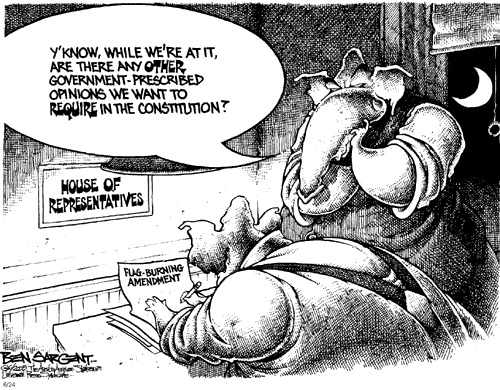
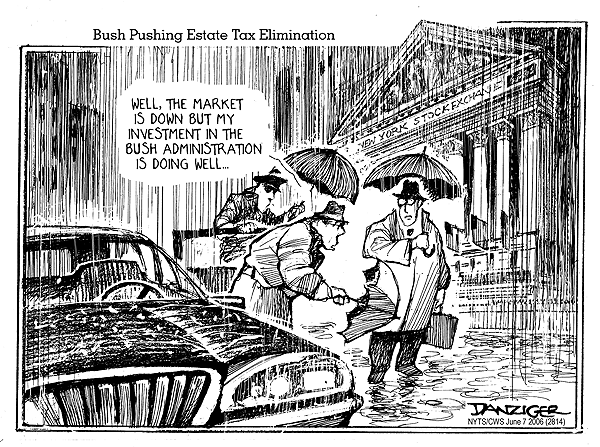
9,000-Plus
If a picture is worth 1,000 words, then these cartoons that have caught my eye of late are worth 9,000...at least: most of them contain words as well, so each would be worth 1,000 words plus however many words are in it, no? Anyway...


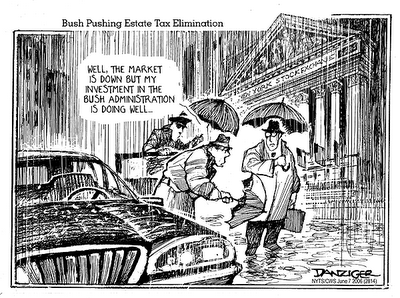

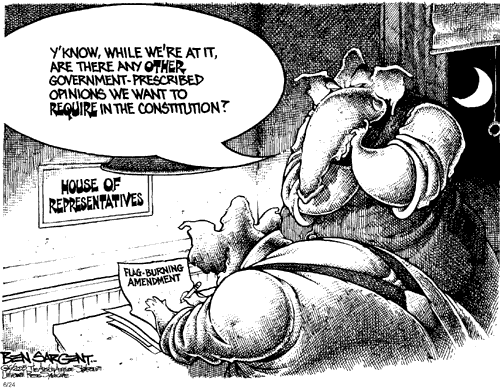
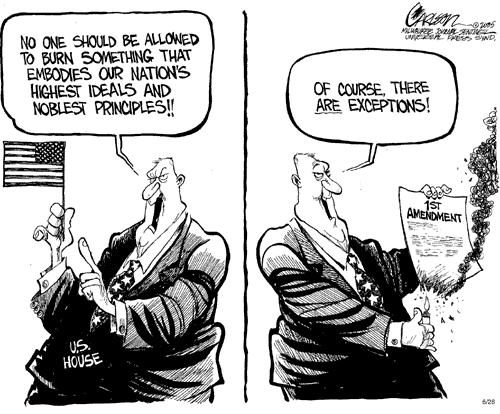


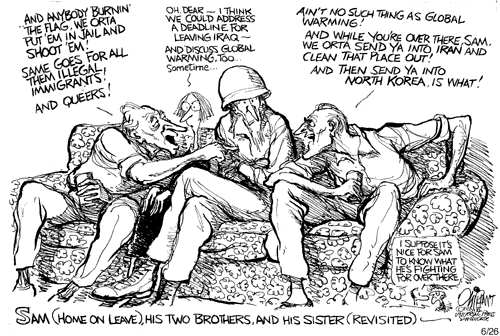



Thursday, June 22, 2006
An Exchange of Questions
A friend sent me the following longish item about abortion, and asked, "How come Lutherans aren't considered at all?"--knowing as he does that I work for a Lutheran organization. I suggested that it could be because Lutheran statements on social issues are generally so long-winded that you have to really want badly to read them. Or it could be that Lutherans, although multitudinous where we live, aren't in the "top three", population-wise, that the article quotes. I don't know the article's origins, but here it is as he sent it to me:
The Bible
Abortion, infanticide and child abandonment were permitted under Roman law at the time of Jesus1. Surprisingly, abortion is never mentioned in the Bible, despite the fact that it has been practiced throughout recorded human history. However, a number of Bible passages may be relevant. These verses and others are often cited as evidence that a fetus is truly a living human being, and deserving the same protection:
At that time Mary got ready and hurried to a town in the hill country of Judea, where she entered Zechariah's home and greeted Elizabeth. When Elizabeth heard Mary's greeting, the baby leaped in her womb, and Elizabeth was filled with the Holy Spirit. In a loud voice she exclaimed: "Blessed are you among women, and blessed is the child you will bear! But why am I so favored, that the mother of my Lord should come to me? As soon as the sound of your greeting reached my ears, the baby in my womb leaped for joy. (NIV, Luke 1:39-44)
Now the word of the LORD came to me saying, "Before I formed you in the womb I knew you, and before you were born I consecrated you; I have appointed you a prophet to the nations." (NAS, Jeremiah 1:4-5)
I will say to God: ... "Your hands shaped me and made me. Will you now turn and destroy me? Remember that you molded me like clay. Will you now turn me to dust again? (NIV, Job 10:2, 8-9)
Several other verses are cited as evidence that a fetus is not a living being. Life is equated with breath throughout the Bible, and this passage seems to suggest that a person is not living until he or she takes a first breath after birth:
The LORD God formed the man from the dust of the ground and breathed into his nostrils the breath of life, and the man became a living being. (NIV, Genesis 2:7)
This passage from Exodus seems to say that causing death to a fetus is not as serious a crime as causing death to a person:
"And if men struggle with each other and strike a woman with child so that she has a miscarriage, yet there is no further injury, he shall surely be fined as the woman's husband may demand of him; and he shall pay as the judges decide. "But if there is any further injury, then you shall appoint as a penalty life for life, eye for eye, tooth for tooth, hand for hand, foot for foot, (NAS, Exodus 21:22-24)
A literal translation of the Hebrew of this passage would be "cause her offspring to be brought forth." It is commonly thought that a miscarriage was meant, but it could mean an early birth where the child survived. Thus, this passage is cited both for and against abortion.
The Bible gives direct guidance on many, many topics, but not on abortion. None of the passages above (nor the many others often cited) were originally intended as statements about abortion, so any conclusions drawn from them represent opinions rather than Biblical evidence.
Opinions
In 1973, the United States Supreme Court, in its Roe v. Wade decision, ruled that a woman has a right to an abortion during the first trimester of pregnancy. However, the 50 states are still allowed to regulate abortion during the second trimester and prohibit it during the third trimester2. Since that time, abortion has become one of the most controversial and divisive issues within society.
Anti-abortion activists represent one extreme of opinion. They believe life begins at the instant of conception. Therefore, abortion is murder and is prohibited by the Ten Commandments (Exodus 20:13). They strongly support laws banning all or almost all abortions.
However, the belief that life begins at conception does not have clear support from medical science, the Bible, religious tradition or legal tradition. Early Christians apparently did not view abortion as murder until well beyond conception. In the thirteenth century, Catholic theologian Thomas Aquinas wrote that a soul enters the body at 40 days after conception for males and 80 days for females. That became church doctrine for many centuries, and abortion before the time of ensoulment was not considered a mortal sin. The belief that life begins at conception apparently has its origins in an 1869 decree by Pope Pius IX that abortion at any point in pregnancy was cause for excommunication.3,4
English common law apparently tolerated abortion until "quickening," the first detectable fetal movements, around the fifth month. Similarly, abortion was largely unregulated in the U.S. until the mid 1800s. Anti-abortion laws were passed around 1900, but the primary reasons had to do with the injuries and deaths resulting from unskilled abortions and a struggle for control of medical practice.5
3Tricia Andryszewski, Abortion, Rights, Options and Choices, Millbrook Press, 1996, p.63.
4Donald P. Judges, Hard Choices, Lost Voices, Ivan R. Dee, 1993, pp. 87-90.
5ibid., pp. 84, 90-106.
Church Doctrine
Many churches, including United Church of Christ,18 Episcopal,19 Presbyterian (USA)20 and United Methodist, do not approve of abortion as a means of birth control. However, they support the right of a woman to obtain an abortion, if she deems that is the best choice in her circumstances, and they favor keeping abortion legal. Other churches, including Roman Catholic and Southern Baptist, oppose all abortions and favor making abortion illegal. Here is a sampling of official church positions from the three largest denominations in the U.S.:
Roman Catholic:
2270. Human life must be respected and protected absolutely from the moment of conception. From the first moment of his existence, a human being must be recognized as having the rights of a person - among which is the inviolable right of every innocent being to life.
2271. Since the first century the Church has affirmed the moral evil of every procured abortion. This teaching has not changed and remains unchangeable. Direct abortion, that is to say, abortion willed either as an end or a means, is gravely contrary to the moral law. From Catechism of the Catholic Church, (c) 1994, United States Catholic Conference, Inc., http://www.nccbuscc.org/catechism/text/index.htm
Southern Baptist:
Procreation is a gift from God, a precious trust reserved for marriage. At the moment of conception, a new being enters the universe, a human being, a being created in God's image. This human being deserves our protection, whatever the circumstances of conception. From Position Statements, Copyright (c) 1999 - 2001, Executive Committee of the Southern Baptist Convention, http://sbc.net/default.asp/url=position-statements.html
United Methodist:
The beginning of life and the ending of life are the God-given boundaries of human existence. While individuals have always had some degree of control over when they would die, they now have the awesome power to determine when and even whether new individuals will be born. Our belief in the sanctity of unborn human life makes us reluctant to approve abortion. But we are equally bound to respect the sacredness of the life and well-being of the mother, for whom devastating damage may result from an unacceptable pregnancy. In continuity with past Christian teaching, we recognize tragic conflicts of life with life that may justify abortion, and in such cases we support the legal option of abortion under proper medical procedures. We cannot affirm abortion as an acceptable means of birth control, and we unconditionally reject it as a means of gender selection. We oppose the use of late-term abortion known as dilation and extraction (partial-birth abortion) and call for the end of this practice except when the physical life of the mother is in danger and no other medical procedure is available, or in the case of severe fetal anomalies incompatible with life. We call all Christians to a searching and prayerful inquiry into the sorts of conditions that may warrant abortion. We commit our Church to continue to provide nurturing ministries to those who terminate a pregnancy, to those in the midst of a crisis pregnancy, and to those who give birth. Governmental laws and regulations do not provide all the guidance required by the informed Christian conscience. Therefore, a decision concerning abortion should be made only after thoughtful and prayerful consideration by the parties involved, with medical, pastoral, and other appropriate counsel. From The Book of Discipline of The United Methodist Church--2000, ¶161J. Copyright 2000 by The United Methodist Publishing House, http://www.umc.org/abouttheumc/policy/
18"Reproductive Rights," United Church of Christ, http://www.ucc.org/justice/choice/
19"Acts of Convention: Resolution # 1994-A054," The Episcopal Church, http://www.episcopalarchives.org/cgi-bin/acts_new/acts_resolution-complete.pl/resolution=1994-A054
20"Abortion," Presbyterian Church (USA), http://www.pcusa.org/101/101-abortion.htm
After I sent him my semi-glib reply, my friend wrote back with this:
How can something that was not a sin for roughly 600 years become a sin? If it were the Latter Day Saints I could accept the state of affairs in that the Prophet routinely receives new instructions. Moreover, if I was going for tradition, I would take 600 years over a 137 years twice a day and three times on Sunday.
What you have to understand about my friend is that he doesn't throw things like this at me (and others, sometimes) as a challenge: he genuinely likes to know what people think. And as a retired college prof, he likes to get people to think.
Anyway, I wrote back with this:
It is most passing strange. As I see it, you can coast along for eons thinking something is hunky-dory; then all of a sudden someone in some kind of position of authority decides it is neither hunky nor dory, and is in fact a sin, indeed a mortal sin, and that's that. It's now immutable, and you can't "go back." That's one thing where a church institution is concerned, but I am more than a little concerned about those who would impose such attitudes on so-called secular society--since of course they're always the "authority." Think Leslee Unruh. No, on second thought, don't: it's too close to bedtime and I wouldn't want you to get heartburn.
Here's something you can 'splain to me: If life begins at conception, then why do we (who practice infant baptism) wait till after birth to baptize' Would it not make more sense to take no chances and baptize in utero as soon as the pregnancy is known?
In re excommunication: One wonders if it carries anywhere near the weight it once did. I suppose in some parts of the world, and in some cultures, it does. But I'm not sure that many of us in danger of excommunication subscribe to the belief that the RCC is the One True Faith and that anyone booted out of it is damned. In my case, my attendance at Mass is so slipshod that I'm not sure if I or anyone else would notice if they gave me the bum's rush.
Saints preserve us from everyone who knows what's best for everyone...
The Bible
Abortion, infanticide and child abandonment were permitted under Roman law at the time of Jesus1. Surprisingly, abortion is never mentioned in the Bible, despite the fact that it has been practiced throughout recorded human history. However, a number of Bible passages may be relevant. These verses and others are often cited as evidence that a fetus is truly a living human being, and deserving the same protection:
At that time Mary got ready and hurried to a town in the hill country of Judea, where she entered Zechariah's home and greeted Elizabeth. When Elizabeth heard Mary's greeting, the baby leaped in her womb, and Elizabeth was filled with the Holy Spirit. In a loud voice she exclaimed: "Blessed are you among women, and blessed is the child you will bear! But why am I so favored, that the mother of my Lord should come to me? As soon as the sound of your greeting reached my ears, the baby in my womb leaped for joy. (NIV, Luke 1:39-44)
Now the word of the LORD came to me saying, "Before I formed you in the womb I knew you, and before you were born I consecrated you; I have appointed you a prophet to the nations." (NAS, Jeremiah 1:4-5)
I will say to God: ... "Your hands shaped me and made me. Will you now turn and destroy me? Remember that you molded me like clay. Will you now turn me to dust again? (NIV, Job 10:2, 8-9)
Several other verses are cited as evidence that a fetus is not a living being. Life is equated with breath throughout the Bible, and this passage seems to suggest that a person is not living until he or she takes a first breath after birth:
The LORD God formed the man from the dust of the ground and breathed into his nostrils the breath of life, and the man became a living being. (NIV, Genesis 2:7)
This passage from Exodus seems to say that causing death to a fetus is not as serious a crime as causing death to a person:
"And if men struggle with each other and strike a woman with child so that she has a miscarriage, yet there is no further injury, he shall surely be fined as the woman's husband may demand of him; and he shall pay as the judges decide. "But if there is any further injury, then you shall appoint as a penalty life for life, eye for eye, tooth for tooth, hand for hand, foot for foot, (NAS, Exodus 21:22-24)
A literal translation of the Hebrew of this passage would be "cause her offspring to be brought forth." It is commonly thought that a miscarriage was meant, but it could mean an early birth where the child survived. Thus, this passage is cited both for and against abortion.
The Bible gives direct guidance on many, many topics, but not on abortion. None of the passages above (nor the many others often cited) were originally intended as statements about abortion, so any conclusions drawn from them represent opinions rather than Biblical evidence.
Opinions
In 1973, the United States Supreme Court, in its Roe v. Wade decision, ruled that a woman has a right to an abortion during the first trimester of pregnancy. However, the 50 states are still allowed to regulate abortion during the second trimester and prohibit it during the third trimester2. Since that time, abortion has become one of the most controversial and divisive issues within society.
Anti-abortion activists represent one extreme of opinion. They believe life begins at the instant of conception. Therefore, abortion is murder and is prohibited by the Ten Commandments (Exodus 20:13). They strongly support laws banning all or almost all abortions.
However, the belief that life begins at conception does not have clear support from medical science, the Bible, religious tradition or legal tradition. Early Christians apparently did not view abortion as murder until well beyond conception. In the thirteenth century, Catholic theologian Thomas Aquinas wrote that a soul enters the body at 40 days after conception for males and 80 days for females. That became church doctrine for many centuries, and abortion before the time of ensoulment was not considered a mortal sin. The belief that life begins at conception apparently has its origins in an 1869 decree by Pope Pius IX that abortion at any point in pregnancy was cause for excommunication.3,4
English common law apparently tolerated abortion until "quickening," the first detectable fetal movements, around the fifth month. Similarly, abortion was largely unregulated in the U.S. until the mid 1800s. Anti-abortion laws were passed around 1900, but the primary reasons had to do with the injuries and deaths resulting from unskilled abortions and a struggle for control of medical practice.5
3Tricia Andryszewski, Abortion, Rights, Options and Choices, Millbrook Press, 1996, p.63.
4Donald P. Judges, Hard Choices, Lost Voices, Ivan R. Dee, 1993, pp. 87-90.
5ibid., pp. 84, 90-106.
Church Doctrine
Many churches, including United Church of Christ,18 Episcopal,19 Presbyterian (USA)20 and United Methodist, do not approve of abortion as a means of birth control. However, they support the right of a woman to obtain an abortion, if she deems that is the best choice in her circumstances, and they favor keeping abortion legal. Other churches, including Roman Catholic and Southern Baptist, oppose all abortions and favor making abortion illegal. Here is a sampling of official church positions from the three largest denominations in the U.S.:
Roman Catholic:
2270. Human life must be respected and protected absolutely from the moment of conception. From the first moment of his existence, a human being must be recognized as having the rights of a person - among which is the inviolable right of every innocent being to life.
2271. Since the first century the Church has affirmed the moral evil of every procured abortion. This teaching has not changed and remains unchangeable. Direct abortion, that is to say, abortion willed either as an end or a means, is gravely contrary to the moral law. From Catechism of the Catholic Church, (c) 1994, United States Catholic Conference, Inc., http://www.nccbuscc.org/catechism/text/index.htm
Southern Baptist:
Procreation is a gift from God, a precious trust reserved for marriage. At the moment of conception, a new being enters the universe, a human being, a being created in God's image. This human being deserves our protection, whatever the circumstances of conception. From Position Statements, Copyright (c) 1999 - 2001, Executive Committee of the Southern Baptist Convention, http://sbc.net/default.asp/url=position-statements.html
United Methodist:
The beginning of life and the ending of life are the God-given boundaries of human existence. While individuals have always had some degree of control over when they would die, they now have the awesome power to determine when and even whether new individuals will be born. Our belief in the sanctity of unborn human life makes us reluctant to approve abortion. But we are equally bound to respect the sacredness of the life and well-being of the mother, for whom devastating damage may result from an unacceptable pregnancy. In continuity with past Christian teaching, we recognize tragic conflicts of life with life that may justify abortion, and in such cases we support the legal option of abortion under proper medical procedures. We cannot affirm abortion as an acceptable means of birth control, and we unconditionally reject it as a means of gender selection. We oppose the use of late-term abortion known as dilation and extraction (partial-birth abortion) and call for the end of this practice except when the physical life of the mother is in danger and no other medical procedure is available, or in the case of severe fetal anomalies incompatible with life. We call all Christians to a searching and prayerful inquiry into the sorts of conditions that may warrant abortion. We commit our Church to continue to provide nurturing ministries to those who terminate a pregnancy, to those in the midst of a crisis pregnancy, and to those who give birth. Governmental laws and regulations do not provide all the guidance required by the informed Christian conscience. Therefore, a decision concerning abortion should be made only after thoughtful and prayerful consideration by the parties involved, with medical, pastoral, and other appropriate counsel. From The Book of Discipline of The United Methodist Church--2000, ¶161J. Copyright 2000 by The United Methodist Publishing House, http://www.umc.org/abouttheumc/policy/
18"Reproductive Rights," United Church of Christ, http://www.ucc.org/justice/choice/
19"Acts of Convention: Resolution # 1994-A054," The Episcopal Church, http://www.episcopalarchives.org/cgi-bin/acts_new/acts_resolution-complete.pl/resolution=1994-A054
20"Abortion," Presbyterian Church (USA), http://www.pcusa.org/101/101-abortion.htm
After I sent him my semi-glib reply, my friend wrote back with this:
How can something that was not a sin for roughly 600 years become a sin? If it were the Latter Day Saints I could accept the state of affairs in that the Prophet routinely receives new instructions. Moreover, if I was going for tradition, I would take 600 years over a 137 years twice a day and three times on Sunday.
What you have to understand about my friend is that he doesn't throw things like this at me (and others, sometimes) as a challenge: he genuinely likes to know what people think. And as a retired college prof, he likes to get people to think.
Anyway, I wrote back with this:
It is most passing strange. As I see it, you can coast along for eons thinking something is hunky-dory; then all of a sudden someone in some kind of position of authority decides it is neither hunky nor dory, and is in fact a sin, indeed a mortal sin, and that's that. It's now immutable, and you can't "go back." That's one thing where a church institution is concerned, but I am more than a little concerned about those who would impose such attitudes on so-called secular society--since of course they're always the "authority." Think Leslee Unruh. No, on second thought, don't: it's too close to bedtime and I wouldn't want you to get heartburn.
Here's something you can 'splain to me: If life begins at conception, then why do we (who practice infant baptism) wait till after birth to baptize' Would it not make more sense to take no chances and baptize in utero as soon as the pregnancy is known?
In re excommunication: One wonders if it carries anywhere near the weight it once did. I suppose in some parts of the world, and in some cultures, it does. But I'm not sure that many of us in danger of excommunication subscribe to the belief that the RCC is the One True Faith and that anyone booted out of it is damned. In my case, my attendance at Mass is so slipshod that I'm not sure if I or anyone else would notice if they gave me the bum's rush.
Saints preserve us from everyone who knows what's best for everyone...
Tuesday, June 20, 2006
Say What?
Here's another bunch of quotations that have been piling up. I think this time all of them--certainly most of them--are from A Word a Day.
We cannot defend freedom abroad by deserting it at home. --Edward R. Murrow, journalist (1908-1965)
We cannot defend freedom abroad by deserting it at home. --Edward R. Murrow, journalist (1908-1965)
One of the best ways to get yourself a reputation as a dangerous citizen these days is to go about repeating the very phrases which our founding fathers used in the great struggle for independence. --Charles A. Beard, historian (1874-1948)
A tyrant must put on the appearance of uncommon devotion to religion. Subjects are less apprehensive of illegal treatment from a ruler whom they consider god-fearing and pious. On the other hand, they do less easily move against him, believing that he has the gods on his side. --Aristotle, philosopher (384-322 BCE)
Permanent good can never be the outcome of untruth and violence. --Mahatma Gandhi (1869-1948)
Civilizations in decline are consistently characterised by a tendency towards standardization and uniformity. --Arnold Toynbee, historian (1889-1975)
Not ignorance, but ignorance of ignorance, is the death of knowledge. --Alfred North Whitehead, mathematician and philosopher (1861-1947)
It is not bigotry to be certain we are right; but it is bigotry to be unable to imagine how we might possibly have gone wrong. --G.K. Chesterton, essayist and novelist (1874-1936)
Be ashamed to die until you have won some victory for humanity. --Horace Mann, educational reformer (1796-1859)
The politician is an acrobat. He keeps his balance by saying the opposite of what he does. --Maurice Barres, novelist and politician (1862-1923)
The simplest questions are the most profound. Where were you born? Where is your home? Where are you going? What are you doing? Think about these once in a while and watch your answers change. --Richard Bach, writer (1936- )
The greatest part of a writer's time is spent in reading, in order to write; a man will turn over half a library to make one book. --Samuel Johnson, lexicographer (1709-1784)
Flattery is like chewing gum. Enjoy it but don't swallow it. --Hank Ketcham, comic artist (1920-2001)
Sit down and put down everything that comes into your head and then you're a writer. But an author is one who can judge his own stuff's worth, without pity, and destroy most of it. --Colette, writer (1873-1954)
Look into any man's heart you please, and you will always find, in every one, at least one black spot which he has to keep concealed. --Henrik Ibsen, playwright (1828-1906)
We shall succeed only so far as we continue that most distasteful of all activity, the intolerable labor of thought. --Learned Hand, jurist (1872-1961)
The question why there is evil in existence is the same as why there is imperfection... But this is the real question we ought to ask: Is this imperfection the final truth, is evil absolute and ultimate? -Rabindranath Tagore, poet, philosopher, author, songwriter, painter, educator, composer, Nobel laureate (1861-1941)
There is also an artificial aristocracy founded on wealth and birth, without either virtue or talents... The artificial aristocracy is a mischievous ingredient in government, and provisions should be made to prevent its ascendancy. --Thomas Jefferson, third
The most radical revolutionary will become a conservative the day after the revolution. --Hannah Arendt, historian and philosopher (1906-1975)
Once you label me you negate me. --Soren Kierkegaard, philosopher (1813-1855)
The trouble with this country is that there are too many politicians who believe, with a conviction based on experience, that you can fool all of the people all of the time. --Franklin P. Adams, columnist (1881-1960)
We either make ourselves happy or miserable. The amount of work is the same. --Carlos Castenada, mystic and author (1925-1998)
I found one day in school a boy of medium size ill-treating a smaller boy. I expostulated, but he replied: 'The bigs hit me, so I hit the babies; that's fair.' In these words he epitomized the history of the human race. --Bertrand Russell, philosopher, mathematician, and author (1872-1970)
One of the oldest human needs is having someone to wonder where you are when you don't come home at night. --Margaret Mead, anthropologist (1901-1978)
When I reflect upon the number of disagreeable people who I know have gone to a better world, I am moved to lead a different life. --Mark Twain, author and humorist (1835-1910)
We must not confuse dissent with disloyalty. --Edward R. Murrow, journalist (1908-1965)
When work is a pleasure, life is a joy! When work is a duty, life is slavery. --Maxim Gorky, author (1868-1936)
Nothing doth more hurt in a state than that cunning men pass for wise. --Francis Bacon, essayist, philosopher, and statesman (1561-1626)
There is only one way to achieve happiness on this terrestrial ball, and that is to have either a clear conscience or none at all. --Ogden Nash, author (1902-1971)
There is a crack in everything. That's how the light gets in. --Leonard Cohen, musician (1934- )
One of the most time-consuming things is to have an enemy. --E.B. White, writer (1899-1985
Sunday, June 18, 2006
And Yet the Myth Persists...
...that Catholic traditions are unchanging.
I refer, of course, to the proposed "new" English translation of the Mass that was foolishly approved by the US Conference of Catholic Bishops last week. "Foolishly" because, I can only assume, the bishops did not hear their clunky translation actually spoken aloud -- otherwise they would never have approved anything as unmelodic as "the Lord be with you" / "And also with your spirit"--"new" because half of what I've read actually sounds like a return to phrases from the Mass of my childhood ("Lord, I am not worthy that you should enter under my roof" is virtually identical to the phrase in use when I took my first communion all those years ago--except it was "come" rather than "enter," and the whole "roof" thing generated a great debate among we second-grade theologians (not second-rate, mind: we were in the second grade) about whether that referred to the roof of one's mouth). Some of it, of course, isn't new at all--there's a reference in this Religion News Service article (via BeliefNet) to the "Dying you destroyed our death" version of the Mystery of Faith: It's not used as often as "Christ has died," but it's used, and it's been in the book forever. Chalk one up for lazy reporters.
However, "the book" brings up another issue that I doubt the bishops have considered, viz., nobody uses the book. I observed quite a few years ago that I was the only one around me who was actually using the throwaway missal that churches go to great expense (I assume) to subscribe to. When that happened, I couldn't say; but it's obvious that everyone has memorized the liturgy, or at least the applicable parts, and have no use of the book. So a change in the wording of the Mass is going to cause a great deal of confusion. The bishops seem to think that an additional expense--laminated cards--will take care of the problem. I think I'd be more in favor of encouraging priests to encourage the faithful to pick up the %$#@! book that's sitting right in front of them, since of course the book will have to be changed if/when Rome approves the alteration, it the publishers want to keep their nihil obstats and imprimaturs and all that other stuff.
Meanwhile, I have to decide if I will "forget" to say "And with your spirit," just as I "forget" to open my arms for the Lord's Prayer. (When did we start doing that? And why, oh, why? Am I the only one who keeps his eyes open and realizes that we look like a bunch of people who are going to start handling snakes at any moment?) The stubborn Irish in me thinks I might just be forgetful; on the other hand, do I want to come off like the old ladies who sit behind us at my wife's Lutheran (ELCA) church and always say, "...one holy, Christian, and apostolic church" in the Apostle's Creed, even though the book has the lowercase catholic and has had for the 25 years I've been hanging around Lutheran churches? Are these women forgetful, stubborn, ignorant, or anti-Catholic? Will I, if "forgetful," be rightly perceived as a poet who detests the bad pacing of "And also with your spirit" (and what the hell does that mean, exactly? The priest does not say, "The Lord be with your spirit" to me; why should I say "And also with your spirit" to him? It not only sounds bad, it's illogical) or one of the old coots who can't/won't keep up with change?
Decisions, decisions. Thanks for nothing, bishops.
I refer, of course, to the proposed "new" English translation of the Mass that was foolishly approved by the US Conference of Catholic Bishops last week. "Foolishly" because, I can only assume, the bishops did not hear their clunky translation actually spoken aloud -- otherwise they would never have approved anything as unmelodic as "the Lord be with you" / "And also with your spirit"--"new" because half of what I've read actually sounds like a return to phrases from the Mass of my childhood ("Lord, I am not worthy that you should enter under my roof" is virtually identical to the phrase in use when I took my first communion all those years ago--except it was "come" rather than "enter," and the whole "roof" thing generated a great debate among we second-grade theologians (not second-rate, mind: we were in the second grade) about whether that referred to the roof of one's mouth). Some of it, of course, isn't new at all--there's a reference in this Religion News Service article (via BeliefNet) to the "Dying you destroyed our death" version of the Mystery of Faith: It's not used as often as "Christ has died," but it's used, and it's been in the book forever. Chalk one up for lazy reporters.
However, "the book" brings up another issue that I doubt the bishops have considered, viz., nobody uses the book. I observed quite a few years ago that I was the only one around me who was actually using the throwaway missal that churches go to great expense (I assume) to subscribe to. When that happened, I couldn't say; but it's obvious that everyone has memorized the liturgy, or at least the applicable parts, and have no use of the book. So a change in the wording of the Mass is going to cause a great deal of confusion. The bishops seem to think that an additional expense--laminated cards--will take care of the problem. I think I'd be more in favor of encouraging priests to encourage the faithful to pick up the %$#@! book that's sitting right in front of them, since of course the book will have to be changed if/when Rome approves the alteration, it the publishers want to keep their nihil obstats and imprimaturs and all that other stuff.
Meanwhile, I have to decide if I will "forget" to say "And with your spirit," just as I "forget" to open my arms for the Lord's Prayer. (When did we start doing that? And why, oh, why? Am I the only one who keeps his eyes open and realizes that we look like a bunch of people who are going to start handling snakes at any moment?) The stubborn Irish in me thinks I might just be forgetful; on the other hand, do I want to come off like the old ladies who sit behind us at my wife's Lutheran (ELCA) church and always say, "...one holy, Christian, and apostolic church" in the Apostle's Creed, even though the book has the lowercase catholic and has had for the 25 years I've been hanging around Lutheran churches? Are these women forgetful, stubborn, ignorant, or anti-Catholic? Will I, if "forgetful," be rightly perceived as a poet who detests the bad pacing of "And also with your spirit" (and what the hell does that mean, exactly? The priest does not say, "The Lord be with your spirit" to me; why should I say "And also with your spirit" to him? It not only sounds bad, it's illogical) or one of the old coots who can't/won't keep up with change?
Decisions, decisions. Thanks for nothing, bishops.
Thursday, June 08, 2006
Defending Marriage
If the goal of the Republican Party (motto: "We'll Do Your Thinking for You") really is to "defend the institution of marriage," would it not make more sense to float a constitutional amendment that would outlaw divorce? Just a thought...
Rediscovery
Often it seems the joy of rediscovering something is even better than the pleasure of the original discovery. Lately, I've been enjoying two rediscoveries.
The first is Leslie Charteris's Simon Templar, aka the Saint. I first began reading this long series of adventures in high school, in the 1970s, beginning with Vendetta for the Saint...which, I later learned, wasn't written by Charteris at all. Oh well. Although I often cite Charteris as an inspiration in my own writing--most recently in a South Dakota Democratic Party podcast for which I was interviewed--it had been some years since I had actually dipped into my library of Saint adventures. Most of my collection is mouldering paperbacks, many dating from the 1940s and 1950s, lovingly acquired at a used-paperback shop (actually an adjunct to a now-defunct gun shop) during my high-school years. Several more are from the Charter Books republications of the 1980s. And then there's the odd hardcover, usually adaptations of TV scripts, several of them part of the "triple volumes" published by the Detective Book Club, which I think sank slowly in the west some decades ago.
Following a e-mail conversations with a friend, I recently made a trip up into the attic (whence I managed to acquire a grade-one concussion) and retrived the box containing my Saint paperbacks, which I am now re-discovering. I started again with Vendetta for the Saint, though it is some 30 years out of order, and have now ventured back to the beginning, with Meet the Tiger (aka The Saint Meets the Tiger) and Enter the Saint--the former being really the first Saint adventure although the second is usually credited as such, and is certainly more "Saint-like" than the first. Lots of fun. As I have often said, and repeated in the podcast, Charteris is the first author I ever read who seemed to be having fun.
At about the same time, I find that I have been listening once more to the music of Boz Scaggs, whom I discovered in college when his best-selling album Silk Degrees was released, as well as his less-well-regarded but still very well done follow-up, Down Two Then Left. I have several of his works since then, and find his voice and stylings very much unlike anyone else's. I recently downloaded Silk Degrees from Napster--my original LP being rendered useless by an uncooperative turntable--and find I enjoy it as much now as when I used to listen to it in my room in Swanson Hall all those years ago. In those days as well I recall making the trek to Lincoln, Nebraska, to catch Scaggs in concert there--still one of the best concerts I've ever attended.
Looks like everything old really is new again!
The first is Leslie Charteris's Simon Templar, aka the Saint. I first began reading this long series of adventures in high school, in the 1970s, beginning with Vendetta for the Saint...which, I later learned, wasn't written by Charteris at all. Oh well. Although I often cite Charteris as an inspiration in my own writing--most recently in a South Dakota Democratic Party podcast for which I was interviewed--it had been some years since I had actually dipped into my library of Saint adventures. Most of my collection is mouldering paperbacks, many dating from the 1940s and 1950s, lovingly acquired at a used-paperback shop (actually an adjunct to a now-defunct gun shop) during my high-school years. Several more are from the Charter Books republications of the 1980s. And then there's the odd hardcover, usually adaptations of TV scripts, several of them part of the "triple volumes" published by the Detective Book Club, which I think sank slowly in the west some decades ago.
Following a e-mail conversations with a friend, I recently made a trip up into the attic (whence I managed to acquire a grade-one concussion) and retrived the box containing my Saint paperbacks, which I am now re-discovering. I started again with Vendetta for the Saint, though it is some 30 years out of order, and have now ventured back to the beginning, with Meet the Tiger (aka The Saint Meets the Tiger) and Enter the Saint--the former being really the first Saint adventure although the second is usually credited as such, and is certainly more "Saint-like" than the first. Lots of fun. As I have often said, and repeated in the podcast, Charteris is the first author I ever read who seemed to be having fun.
At about the same time, I find that I have been listening once more to the music of Boz Scaggs, whom I discovered in college when his best-selling album Silk Degrees was released, as well as his less-well-regarded but still very well done follow-up, Down Two Then Left. I have several of his works since then, and find his voice and stylings very much unlike anyone else's. I recently downloaded Silk Degrees from Napster--my original LP being rendered useless by an uncooperative turntable--and find I enjoy it as much now as when I used to listen to it in my room in Swanson Hall all those years ago. In those days as well I recall making the trek to Lincoln, Nebraska, to catch Scaggs in concert there--still one of the best concerts I've ever attended.
Looks like everything old really is new again!
Monday, May 29, 2006

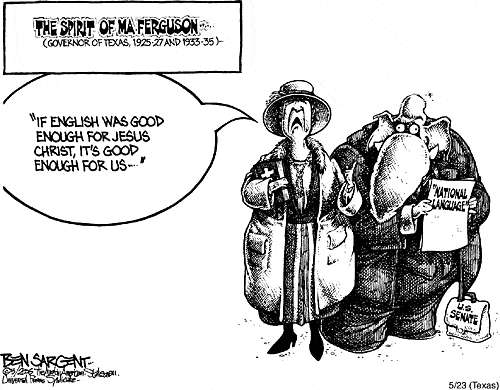


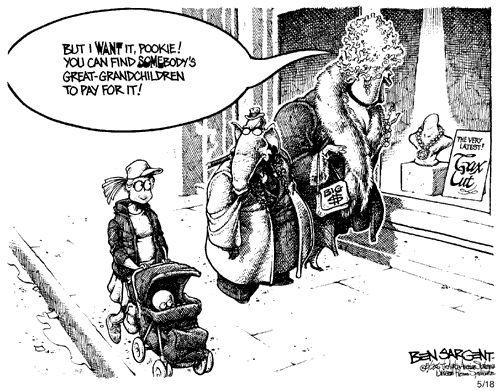
Memorial Day
Memorial Day, and once again I find myself uncomfortable over some of the sentiments expressed in editorials and from pulpits. Although I have a great deal of respect for the men and women who serve and have served in the armed forces, the little hairs on the back of my neck come to attention when I hear solemn references to those who have lost their lives in the Middle East "defending our freedom."
Hmm.
There's no denying that they died in service to our country, and for that alone they are deserving of honor and thanks. It's the "defending our freedom" part that puzzles me, since I have yet to discover how exactly Iraq ever posed any threat to the United States at all, let alone our "freedom."
Such statements, although obviously intended to honor fallen troops--a worthy and noble aim--in fact tend to implicitly support a pointless and immoral war, and to gloss over the tragedy that these men and women should have died because of the short-sighted hubris of our political "leaders."
So let's honor those who have died in service to the nation. But let's be accurate about it.
Hmm.
There's no denying that they died in service to our country, and for that alone they are deserving of honor and thanks. It's the "defending our freedom" part that puzzles me, since I have yet to discover how exactly Iraq ever posed any threat to the United States at all, let alone our "freedom."
Such statements, although obviously intended to honor fallen troops--a worthy and noble aim--in fact tend to implicitly support a pointless and immoral war, and to gloss over the tragedy that these men and women should have died because of the short-sighted hubris of our political "leaders."
So let's honor those who have died in service to the nation. But let's be accurate about it.
Tuesday, May 23, 2006
Who Said That?
A bunch more quotations. As usual, most (perhaps all) are from A Word a Day's e-mails.
Once upon a time a man whose ax was missing suspected his neighbor's son. The boy walked like a thief, looked like a thief, and spoke like a thief. But the man found his ax while digging in the valley, and the next time he saw his neighbor's son, the boy walked, looked and spoke like any other child. -Lao-tzu, philosopher (6th century BCE)
Good books don't give up all their secrets at once. -Stephen King, novelist (1947- )
You must accept the truth from whatever source it comes. -Moses ben Maimon, philosopher (1135-1204)
Experience makes us see an enormous difference between piety and goodness. -Blaise Pascal, philosopher and mathematician (1623-1662)
Whenever anyone has offended me, I try to raise my soul so high that the offense cannot reach it. -Rene Descartes, philosopher and mathematician (1596-1650)
If Tyranny and Oppression come to this land, it will be in the guise of fighting a foreign enemy. -James Madison, fourth US president (1751-1836)
The horse is not judged by the saddle. -German proverb
Rare is the person who can weigh the faults of others without putting his thumb on the scales. -Byron J. Langenfeld
War loses a great deal of romance after a soldier has seen his first battle. -John Singleton Mosby, confederate colonel in the American Civil War (1833-1916)
Once upon a time a man whose ax was missing suspected his neighbor's son. The boy walked like a thief, looked like a thief, and spoke like a thief. But the man found his ax while digging in the valley, and the next time he saw his neighbor's son, the boy walked, looked and spoke like any other child. -Lao-tzu, philosopher (6th century BCE)
Good books don't give up all their secrets at once. -Stephen King, novelist (1947- )
You must accept the truth from whatever source it comes. -Moses ben Maimon, philosopher (1135-1204)
Experience makes us see an enormous difference between piety and goodness. -Blaise Pascal, philosopher and mathematician (1623-1662)
Whenever anyone has offended me, I try to raise my soul so high that the offense cannot reach it. -Rene Descartes, philosopher and mathematician (1596-1650)
If Tyranny and Oppression come to this land, it will be in the guise of fighting a foreign enemy. -James Madison, fourth US president (1751-1836)
The horse is not judged by the saddle. -German proverb
Rare is the person who can weigh the faults of others without putting his thumb on the scales. -Byron J. Langenfeld
War loses a great deal of romance after a soldier has seen his first battle. -John Singleton Mosby, confederate colonel in the American Civil War (1833-1916)
Monday, May 01, 2006

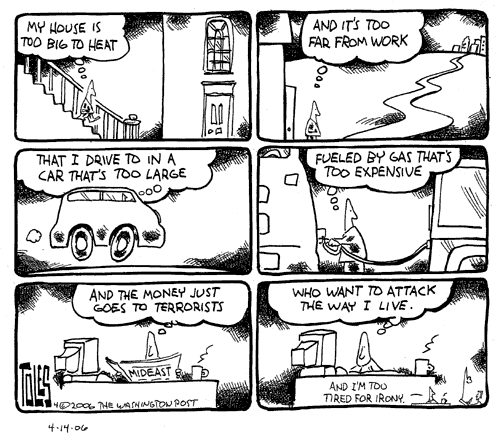

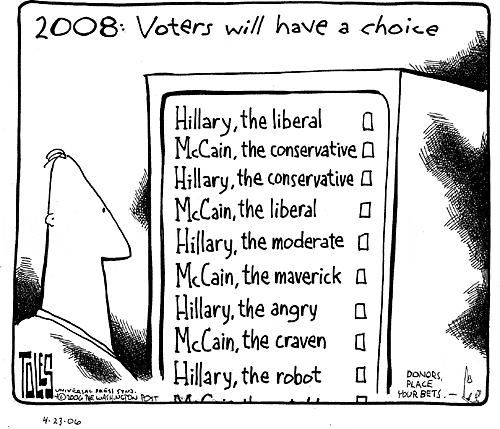
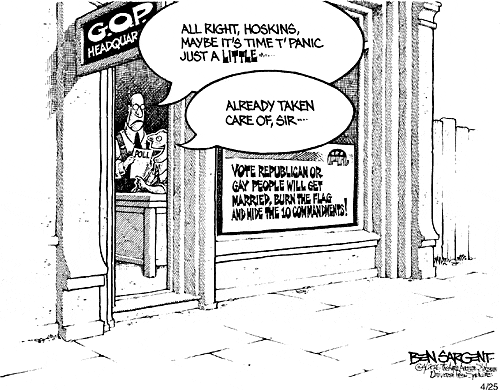

Subscribe to:
Posts (Atom)